Preparation of the National Adaptation Plan for the Libyan Government
Libya faces rising temperatures, declining rainfall, extreme weather and sea-level rise, putting water resources, agriculture and coastal communities under pressure. Strengthening climate governance and adaptation planning is essential to address these risks and translate international climate commitments into national action.
Through the Sustainable Transition, Energy and Environmental Partnership (STEP) and Climate and Sustainable Energy Partnership (CASEP), Dorsch Impact supports Libya’s Ministry of Environment and partner institutions in developing the National Adaptation Plan and three sectoral adaptation plans, strengthening national and local climate governance, and advancing climate reporting and climate-finance capacity. Working with ministries, municipalities, civil society and a local NGO, as well as coordinating with the United Nations Development Programme (UNDP) on Libya’s Nationally Determined Contribution (NDC) and its Initial National Communication (INC), Dorsch Impact provides climate risk assessments, gender-responsive stakeholder engagement, institutional capacity development, and practical adaptation and finance planning focused on water, agriculture and biodiversity under the United Nations Framework Convention on Climate Change (UNFCCC).
Areas of Expertise
- Climate Action
Client
Deutsche Gesellschaft für Internationale Zusammenarbeit (GIZ) GmbH, financed by the EU and the German Federal Ministry for Economic Cooperation and Development (BMZ)
Duration
From 2024 to 2027
Location
Libya
Project Activities
Institutional Component
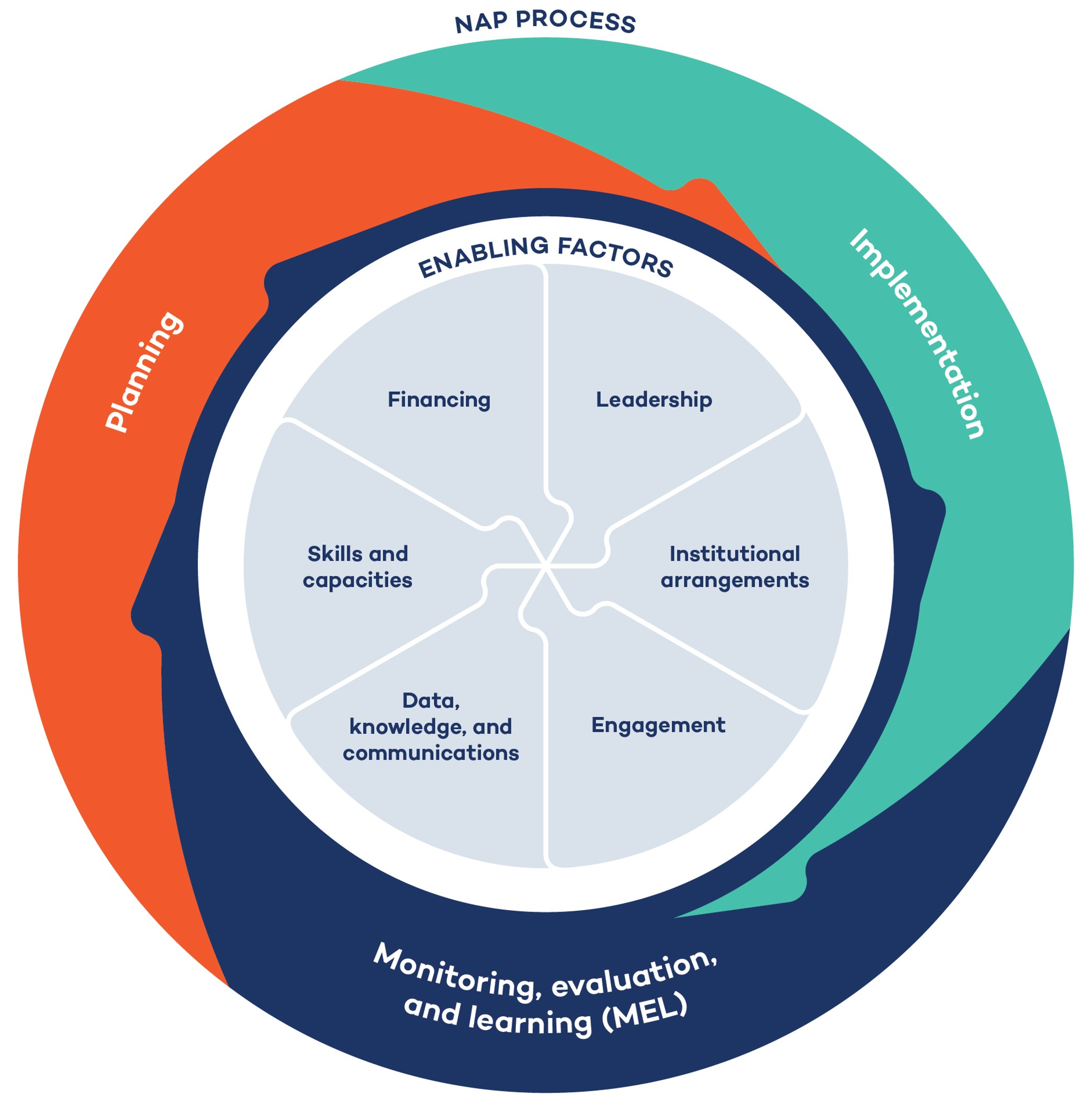
Framing and facilitating a participatory, multi-stakeholder NAP process, including a living evidence and stakeholder-mapping resource, gender-responsive capacity development, coordination and dialogue, a roadmap with roles and timelines, and monitoring and review arrangements.
Supporting the establishment of Climate Change Units in the ministries responsible for water, agriculture and environment, and strengthening institutional coordination for climate planning.
Supporting the Ministry of Environment and partner institutions to review and consolidate the NAP and three sectoral adaptation plans, facilitate interministerial dialogue and approval, prepare sectoral operational schedules, and advise on and facilitate submission to the UNFCCC.
Advising and coaching a local NGO to support three partner municipalities on climate and conflict resilience, including municipal Climate Change Units, local training, inclusive participatory risk assessments with women, youth, migrants and other disadvantaged groups, quality assurance, and community peer-to-peer learning.
Technical Component
Conducting gender-sensitive training and participatory climate risk assessments at national and sectoral levels for water, agriculture and biodiversity, covering flood, desertification, biodiversity-loss and food-security risks and the water–food–biodiversity nexus, with municipal assessments and quality assurance.
Identifying, assessing and prioritising adaptation measures and preparing the draft NAP and three sectoral adaptation plans, with monitoring arrangements and measures for early warning, flood prevention, sustainable water access, desalination, desertification, sustainable agriculture, food security and biodiversity conservation.
Developing Libya’s NDC adaptation chapter in coordination with UNDP’s mitigation work, including stakeholder engagement and review; integration of national policies and adaptation–mitigation synergies; adaptation goals, nature-based and technological measures, implementation and resource-mobilisation arrangements; and monitoring, reporting, communication, capacity development and public-consultation arrangements, supporting finalisation for national submission.
Reviewing and harmonising the National Communication’s approach and available inputs, including national circumstances, GHG inventory and mitigation chapters in coordination with UNDP; developing or completing chapters on vulnerability and adaptation, cross-cutting issues (including gender, Indigenous Peoples and just transition), support needs, constraints and recommendations, additional information and annexes; and harmonising the report and executive summary for submission.
Developing climate change adaptation curricula and a train-the-trainer course with one university and one technical and vocational education and training (TVET) institution.
Developing a climate change adaptation finance strategy with three project ideas, advising on a water–agriculture nexus lighthouse initiative (for example, solar-powered pumping with drip irrigation), and preparing regional and international knowledge-exchange formats.
Building climate-finance capacity through a Training of Trainers programme for up to 18 experts; practical training on relevant mechanisms, including the Green Climate Fund (GCF), Global Environment Facility (GEF) and Adaptation Fund; and concept-level adaptation, mitigation and cross-cutting intervention ideas based on NAP, NDC and sector priorities. Consolidating training materials, outcomes and recommendations for institutional follow-up.
Impact
- Strengthening national institutions’ capacity to assess climate risks and translate evidence into adaptation priorities and plans.
- Supporting national ownership of climate action through cooperation between ministries, technical institutions, civil society and municipalities.
- Providing a coherent technical basis for the National Adaptation Plan and three sectoral plans, the NDC adaptation chapter and the Initial National Communication, while strengthening capacity to translate climate priorities into financeable actions.
- Laying the foundations for long-term climate resilience in water management, agriculture and biodiversity conservation, and strengthening municipal climate and conflict resilience in basic services and livelihoods while supporting Libya’s international climate commitments.
Contributing to the UN Sustainable Development Goals
We are committed to making a positive impact and supporting the UN Sustainable Development Goals (SDGs). This project contributes to the following SDGs: